
This guide covers 7 ways a farm telehandler really benefits daily farm work. No fluff. No sales pitch. Just practical reasons why this machine belongs on your farm.
Table of Contents
- What Makes It Different
- 1. Moving Hay Bales Becomes Effortless
- 2. Feeding Livestock Gets Faster
- 3. Cleaning Barns and Pens Becomes Simple
- 4. Loading and Unloading Trucks
- 5. Handling Grain and Silage
- 6. Moving Equipment and Supplies
- 7. Working in All Weather Conditions
- Attachments You Will Use
- Comparing with Tractor Loaders
- Safety Tips
- Maintenance Checklist
- Machine Costs
- Uses in Different Seasons
- Comparing with Skid Steers
- Our Business Partner (Video)
- Final Thoughts
Farming is hard work. Long hours. Heavy lifting. Tight schedules. Every farmer knows the struggle of moving feed, hay, equipment, and supplies.
Machines help. But not all machines are created equal. Some are limited. Some break down. Some cost more than they save.
A farm telehandler changes that. It is built for the rough conditions of farm life. It lifts. It moves. It reaches. It does things other machines cannot.
What Makes a Farm Telehandler Different
A farm telehandler is not the same as a construction telehandler. The basic machine is similar. But the application is different.
On a farm, you deal with mud, dust, and tight barn spaces. You move hay bales, feed, grain, and equipment. You work in all weather conditions.
This agricultural telehandler is built for these conditions. The tires are designed for soft ground. The cab is sealed against dust. The attachments are made for agricultural tasks.
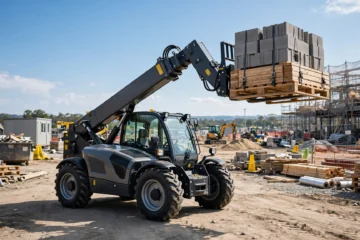
The telescopic boom gives you reach. You stack hay in tall barns. You load trucks from a distance. You place materials where other machines cannot reach.
Now let us get into the 7 ways this machine benefits your daily work.
1. Moving Hay Bales Becomes Effortless
Hay bales are heavy. Round bales weigh 1,000 to 2,000 pounds. Square bales weigh 800 to 1,500 pounds. Moving them by hand is impossible. Moving them with a tractor takes time.
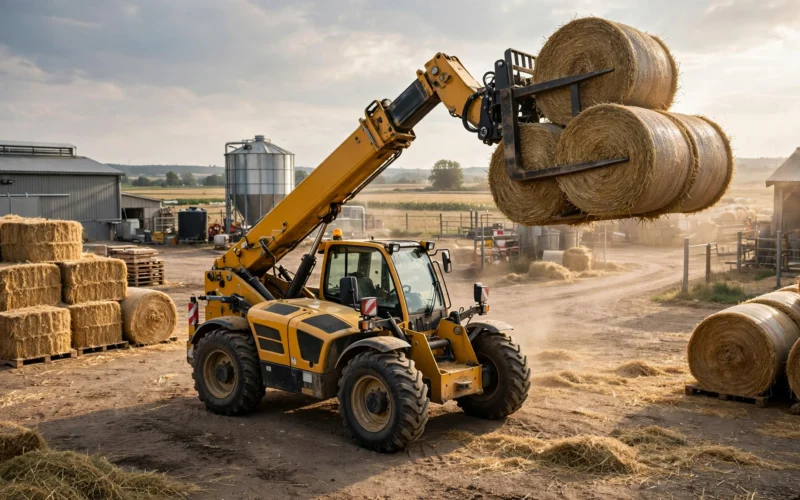
A telehandler with a bale spear attachment picks up bales easily. You drive up to the bale. You spear it. You lift it. You move it where you want it.
The boom reaches high. You stack bales three or four high in barns. You save floor space. You organize your feed better. You also move bales from field to storage. The machine handles rough terrain. It does not get stuck in soft ground.
A farm telehandler reduces the time spent moving hay. What used to take hours now takes minutes. That is time you can spend on other work.
2. Feeding Livestock Gets Faster
Feeding livestock is a daily chore. Cows, horses, sheep, goats. All need feed. All need water. All need attention.
A farm telehandler with a bucket or grapple moves feed quickly. You scoop silage from the pile. You carry it to the feed bunk. You dump it in place.
The boom reaches over fences. You do not need to drive into the pen. You stay outside. The animals stay calm. You also move hay bales to feeding areas. You place them where the animals can reach them. You do not need to handle each bale by hand.
Feeding time becomes faster and easier. Your animals get fed on schedule. You have more time for other chores.
3. Cleaning Barns and Pens Becomes Simple
Barns get dirty. Animals produce waste. Bedding needs changing. Cleaning is a daily or weekly chore.
A telehandler with a bucket attachment cleans barns and pens. You scoop manure and soiled bedding. You carry it to the manure pile. You dump it. The boom reaches into tight corners. You clean areas that other machines cannot reach. Your barn stays cleaner.
You also spread fresh bedding. You scoop sawdust or straw. You spread it in the pens. Your animals stay comfortable. Cleaning is still work.
But a farm telehandler makes it faster. You spend less time cleaning. You spend more time on productive work.
4. Loading and Unloading Trucks Becomes Efficient
Trucks arrive with feed, supplies, and equipment. You need to unload them. You also need to load trucks for transport.
A farm telehandler with forks handles pallets and supplies. You lift pallets from the truck. You move them to storage. You stack them neatly.
The boom reaches into the truck bed. You do not need to climb in. You stay on the ground. It is safer. You also load trucks for transport. You lift hay, grain, or equipment onto the truck. You position it correctly. You secure it for travel.
Loading and unloading becomes faster. Trucks spend less time on your farm. You get more work done.
5. Handling Grain and Silage Becomes Easier
Grain and silage are heavy and bulky. Moving them takes effort.
A farm telehandler with a bucket handles both. You scoop grain from the bin. You carry it to the feeder or truck. You dump it where needed. You scoop silage from the pile. You carry it to the feed bunk. You spread it evenly.
The boom reaches over tall bins and walls. You do not need to climb. You stay on the ground. It is safer and faster.
An agricultural telehandler also helps with grain storage. You move grain into bins. You move it out for sale or feeding. The process becomes smooth.
6. Moving Equipment and Supplies Becomes Convenient
Farms have equipment. Tractors, implements, tools, parts. Moving them around takes effort. A telehandler with forks or a winch moves equipment. You lift implements onto trailers. You position them in the workshop. You move them to the field.
The boom reaches into tight storage areas. You retrieve items from the back of the shed. You move them without climbing over other equipment. You also move supplies like fencing, posts, and lumber. You carry them to the work area. You place them where you need them.
A farm telehandler becomes your go-to machine for moving anything. It saves your back. It saves your time.
7. Working in All Weather Conditions Becomes Reliable
Farming does not stop for weather. Rain, snow, mud, and heat. You still have work to do. This machine is built for these conditions. Four-wheel drive keeps you moving. Large tires provide traction in mud. The cab keeps you comfortable.
You work in rain without getting wet. The cab has heat and air conditioning. You stay comfortable in any weather. The machine does not get stuck easily. The tires are designed for soft ground. The ground clearance keeps you moving. You stay productive in any weather. Rain does not stop you. Mud does not stop you.
A farm telehandler keeps you working.
Farm Telehandler Attachments You Will Use
An agricultural machine is versatile because of attachments. Here are the ones you will use most.
| Attachment | Primary Farm Use |
|---|---|
| Bale Spear | For moving hay and straw bales. Spear the bale, lift it, move it. |
| Bucket | For moving grain, silage, feed, and bedding. Scoop, lift, dump. |
| Forks | For pallets, equipment, and supplies. Standard and useful. |
| Grapple | For logs, brush, and irregular loads. Grab and move. |
| Work Platform | For elevated work. Changing lights. Repairing roofs. |
| Winch | For pulling equipment and vehicles. Drag things into place. |
Each attachment adds a new capability. One agricultural telehandler does the work of several machines.
Farm Telehandler vs Tractor Loader
Farmers often compare telehandlers to tractor loaders. Both have uses.
But this telehandler offers advantages. A tractor loader lifts straight up. The bucket is in front. You drive up to the load. You lift it. A telehandler reaches forward and up. You place loads where the tractor cannot reach. You reach over fences, walls, and obstacles.
A tractor loader is good for ground-level work. A farm machine is better for stacking and placing. The boom gives you reach the tractor lacks. The telehandler also has better visibility. The boom does not block your view. You see what you are doing. Tractor loaders are cheaper.
But an agricultural telehandler is more versatile. It does more work on the farm.
Farm Telehandler Safety Tips
Operating this machine is safe if you follow the rules. Here are some safety tips:
- Know Your Load Capacity: Do not exceed the load chart. Know your limits. Overloading causes tipping.
- Keep the Boom Low When Traveling: A raised boom is unstable. Lower it before driving. Keep it just above the ground.
- Use a Spotter in Tight Spaces: Barns and sheds are tight. Use a spotter to guide you. They see what you cannot.
- Wear Your Seat Belt: Seat belts save lives. Wear yours every time. Do not start without it.
- Avoid Slopes When Lifting: Lifting on a slope is dangerous. The load shifts. The machine tips.
- Check Your Machine Daily: Inspect before you work. Look for leaks, damage, and wear. Fix problems early.
- Train Your Operators: Everyone who operates the machine needs training. Practice before you work.
Farm Telehandler Maintenance Tips
Regular maintenance keeps your equipment running. Follow these tips:
| Maintenance Task | Frequency | Details |
|---|---|---|
| Grease Daily | Every Day | Grease the boom pins and all pivot points to prevent wear. |
| Check Fluids | Every Day | Engine oil, hydraulic fluid, coolant, brake fluid. Top up as needed. |
| Check Tires | Weekly | Check pressure. Look for cuts and damage. Replace worn tires. |
| Change Filters | On Schedule | Air filters, fuel filters, hydraulic filters. Clean filters keep it running. |
| Inspect Hoses & Belts | Regularly | Look for cracks and wear. Replace damaged hoses and belts. |
| Keep a Log | Ongoing | Track hours, service, and repairs to plan maintenance ahead. |
Cost of a Farm Telehandler
This equipment costs less than you think. Small models start around $50,000. Mid-size models cost $70,000 to $90,000. Large models go up to $130,000. Used models cost less. A good used machine is $30,000 to $60,000. Check hours and condition.
Attachments cost extra. A bale spear costs $500 to $1,000. A bucket costs $1,000 to $3,000. Forks are usually included. Maintenance costs are reasonable. Annual maintenance is $2,000 to $4,000. The machine pays for itself in time saved. It replaces multiple machines. It makes your work faster and easier.
Farm Telehandler Uses in Different Seasons
This machine is useful year-round. Each season brings different work.
| Season | Typical Farm Work |
|---|---|
| Spring | Moving supplies for planting. Loading seed and fertilizer. Cleaning barns. |
| Summer | Moving hay bales. Handling grain harvest. Feeding livestock. |
| Fall | Moving silage. Handling equipment for harvest. Cleaning pens for winter. |
| Winter | Moving feed in snow. Handling bedding. Clearing snow from pathways. |
The agricultural telehandler works in every season. It is not a seasonal machine. It works year-round.
Farm Telehandler vs Skid Steer
Skid steer loaders are common on farms. They are compact and agile.
But an agricultural machine offers advantages. A skid steer lifts straight up. The loader arms are in front. You drive up to the load. The telehandler reaches forward and up. You place loads over obstacles. You reach high places.
A skid steer works on hard ground. This farm machine works in mud. The tires are larger. The ground clearance is higher. Skid steers are cheaper.
But a telehandler is more versatile. It does more work.
Our Business Partner
Final Thoughts
A farm telehandler is a valuable machine for any farm. It moves hay bales effortlessly. It feeds livestock faster. It cleans barns and pens simply. It loads and unloads trucks efficiently. It handles grain and silage easily. It moves equipment and supplies conveniently. It works in all weather conditions reliably.
Attachments expand its capability. A bale spear, bucket, forks, grapple, and work platform. Each tool adds a new function. Safety and maintenance are important. Follow the rules. Inspect the machine daily. Grease it daily. Change filters on schedule.
Costs are reasonable. The machine pays for itself in time saved. It replaces multiple machines. It makes daily farm work faster and easier.
Every farmer should consider a farm telehandler. It is a practical investment. It will serve your farm for years.


[…] a big investment. It works hard every day. It lifts heavy loads. It moves through mud and dust. It operates in all weather conditions. Without proper care, breakdowns happen. Repairs cost money. Downtime costs even more. A machine […]