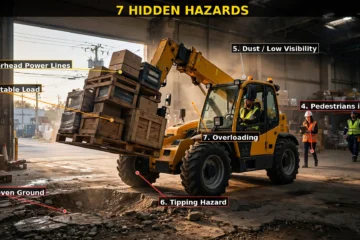

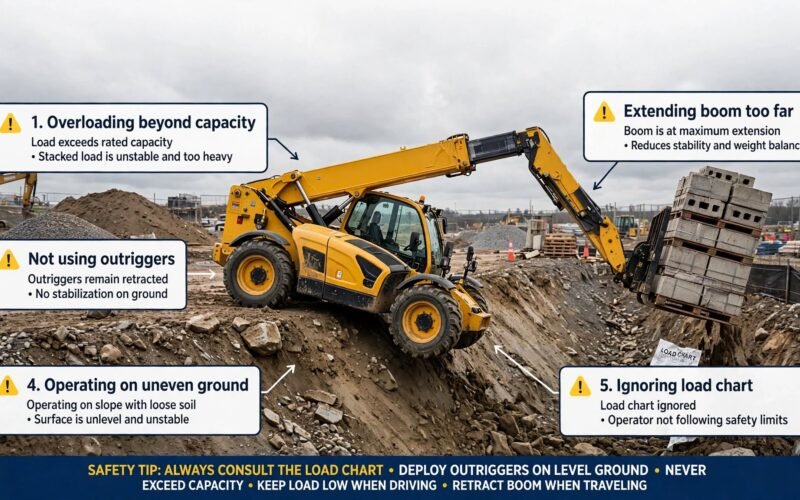
Ignoring the telehandler load chart causes accidents that are not due to bad luck or mechanical failure, but pure human error. Every machine has one sitting on the cab door or window. It shows how much weight the machine lifts at different boom angles and extensions. It exists to prevent tip-overs.
Table of Contents
- 1. Reading Capacity at the Wrong Boom Angle
- 2. Ignoring Boom Extension Limits
- 3. Forgetting Attachment Weight
- 4. Miscalculating Load Weight
- 5. Ignoring Ground Conditions
- Why These Errors Keep Happening
- How to Read the Chart Correctly
- Safety Rules and Myths
- Our Business Partner (Video)
- Final Thoughts
Operators ignore it every day. They guess. They assume. They lift loads too heavy for the boom position. The machine tips. The load falls. People get hurt.
Five errors cause most of these accidents. All five are preventable.
1. Reading Capacity at the Wrong Boom Angle
An operator checks the telehandler load chart once at the start of the shift. Then lifts at a completely different boom angle. That does not work.
The chart changes with angle. A load safe with the boom high is not safe with the boom low. Same weight. Same machine. Different angle. Different capacity. At a low boom angle, the load sits far from the machine. Leverage increases. Capacity drops.
Take a typical machine. It lifts its full rating with the boom high. Lower that boom to a shallow angle and the rating falls sharply. Keep lifting the original load and the machine tips.
So read the telehandler load chart at the exact boom angle. Not an average. Not a guess. Charts show rows for every few degrees. Match the angle. Read the capacity.
Boom angle indicators come standard on modern machines. Watch the angle while lifting. If it changes mid-lift, check the chart again. A successful lift at one angle guarantees nothing at another angle.
2. Ignoring Boom Extension Limits
Extension is the next problem area.
The telehandler load chart shows capacity at different extension lengths. Fully retracted carries more. Fully extended carries less.
Operators extend the boom to reach a load. They forget to check capacity at that extension. They rely on the retracted rating. If you find your equipment regularly pushed past safe limits, upgrading to heavy-duty options like a Typhon Stomp 9000 lbs Skid Steer Loader might be necessary. However, relying purely on retracted ratings on a boom causes the load to be too heavy. The machine tips.
At full extension, most machines carry a small fraction of their retracted capacity. The boom acts like a long lever. The further it reaches, the less it holds.
Why does this error happen. Because the load looks manageable. The machine lifted it at retraction. So the operator assumes it lifts at extension. Wrong.
Read the telehandler load chart for the exact extension length. Charts show capacities for specific lengths. Match the length. Read the capacity.
Extension indicators show current length. Check the chart before extending. If the load is too heavy at the required extension, change the approach. Reduce the load. Move the machine closer. Do not lift.
3. Forgetting Attachment Weight
Attachments add weight. That weight counts against the telehandler load chart.
Operators forget this constantly. They calculate capacity based on the bare machine. The attachment pushes the total over the limit. The machine tips.
Every attachment has weight. Forks, buckets, jibs, platforms. Each one subtracts from the rated capacity. The heavier the attachment, the bigger the loss. A bucket eats hundreds of pounds of capacity. A work platform eats more.
A machine rated at a certain capacity with forks holds that number. Add a heavy bucket and the real limit drops. An operator who ignores this lifts the original load. The machine tips.
The telehandler load chart includes attachment weight in the calculation. Subtract the attachment weight from rated capacity. Or use the attachment-specific chart. Many manufacturers provide separate charts for common attachments.
Always check the telehandler load chart with the attachment installed. Never use the base machine chart. The numbers differ. Capacity is lower. Weigh the attachment if the weight is unknown. A scale costs less than a tip-over.
Attachments also shift the center of gravity. A heavy bucket pushes the load forward. Leverage on the boom increases. Capacity drops further.
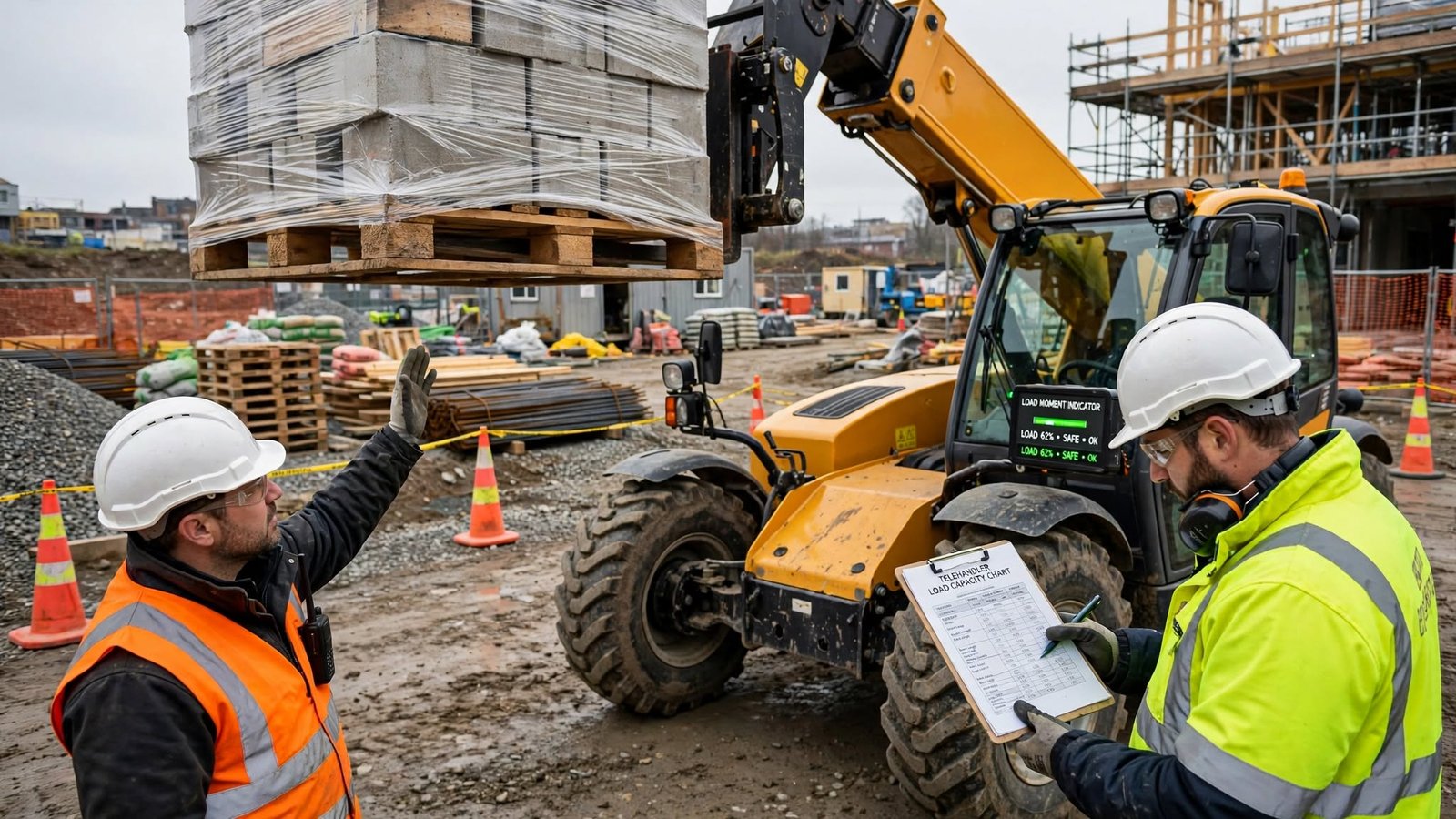
4. Miscalculating Load Weight
The telehandler load chart shows capacity in pounds. The operator must know the actual weight of the load. Most do not.
They guess. They estimate. They are wrong. A pallet of bricks weighs more than it looks. Wet lumber weighs more than dry. Steel weighs far more than wood.
Operators load the machine based on appearance. The load looks reasonable. The machine lifts it. The boom flexes. The tires compress. Whether you use a heavy telehandler or one of the TYPHON skid steer models, overloading causes tipping.
Weigh the load before lifting. A scale on the forklift. A platform scale. A truck scale. Any reliable method. Know the number. If weighing is impossible, use conservative estimates. Know common material weights.
Gravel is heavy. Sand is heavy. Wet topsoil is heavy. A pallet of bricks is heavy. A pallet of concrete blocks is heavier.
Never assume a load is light because it looks small. Density matters more than size. A small block of steel outweighs a large bag of insulation. The telehandler load chart requires accurate weight. Guesswork causes tip-overs.
5. Ignoring Ground Conditions
The telehandler load chart assumes level, solid ground.
Real job sites are not level. They are not solid. Soft ground reduces stability. Sloped ground shifts the load. Capacity drops.
Operators check the telehandler load chart. The load is within capacity. They lift. The ground gives way. The machine tips.
Soft ground compresses under the tires. The machine leans. The load shifts. The center of gravity moves outside the stability triangle. The machine tips. Sloped ground does the same. The load leans downhill. Leverage increases. Capacity drops.
The telehandler load chart assumes ideal conditions. Real conditions require derating. Reduce the load on soft ground. Reduce the load on slopes. Reduce the load on uneven surfaces.
Check the ground before lifting. Walk the area. Look for soft spots. Look for slopes. Look for recent excavation. If the ground is questionable, use mats. Steel plates spread the weight. They provide a stable base.
Never lift on a slope without derating. Never lift on soft ground without derating. The telehandler load chart does not cover these conditions. The operator must adjust.
Why These Errors Keep Happening
Lack of Training
Many operators never receive formal training on the telehandler load chart. They learn by watching. They learn by doing. They learn wrong.
Complacency
Experienced operators think they know the machine. They stop checking the chart. They rely on memory. Memory is unreliable. The chart is reliable.
Time Pressure
Deadlines create pressure. Operators skip the chart check to save time. The saved time costs more in repairs and downtime.
Poor Chart Placement
Some telehandler load charts are hard to read. Small. Faded. Placed where the operator cannot see them easily. Make the chart accessible. Replace faded charts.
Language Barriers
Some operators do not read the language on the chart. They guess. They rely on others. Provide charts in the operator’s language.
How to Read the Chart Correctly
| Step | Action Required |
|---|---|
| 1: Identify the Boom Angle | Check the angle indicator. Find the matching row on the chart. |
| 2: Identify the Extension Length | Check the extension indicator. Find the matching column on the chart. |
| 3: Find the Intersection | The intersection shows the maximum load at that angle and extension. |
| 4: Subtract Attachment Weight | If using an attachment, subtract its weight from the capacity. |
| 5: Weigh the Load | Compare actual weight to capacity. If it exceeds capacity, do not lift. |
| 6: Check Ground Conditions | If ground is soft or sloped, derate the capacity and reduce the load further. |
Safety Rules That Prevent Tip-Overs
- Always read the chart before lifting.
- Match the angle and extension exactly.
- Subtract attachment weight.
- Weigh the load before lifting.
- Derate for ground conditions.
- Never exceed the capacity.
- Use a spotter when visibility is limited.
- Stop if the machine feels unstable.
Myths That Get Operators Hurt
The Capacity Is the Same at All Angles: False. Capacity drops as the angle decreases. Read the chart.
The Capacity Is the Same at All Extensions: False. Capacity drops as the boom extends. Read the chart.
Attachments Do Not Affect Capacity: False. Attachments add weight. They reduce capacity.
Ground Conditions Do Not Matter: False. Soft or sloped ground reduces stability. Derate the load.
Experience Replaces the Chart: False. Experience helps. The chart is still required.
Our Business Partner
Final Thoughts
Five errors cause most telehandler load chart tip-overs. Reading capacity at the wrong angle. Ignoring extension limits. Forgetting attachment weight. Miscalculating load weight. Ignoring ground conditions. All five are preventable.
Read the chart correctly. Match the angle and extension. Subtract attachment weight. Weigh the load. Check the ground.
The telehandler load chart is the most important safety document on the machine. It prevents accidents. It saves lives. It saves money.
Read it before every lift. Do not guess. Do not assume. Do not rely on memory. The chart is the truth. Follow it.
Train every operator on the telehandler load chart. Test their knowledge. Refresher training keeps skills sharp.
The machine is powerful. The load is heavy. The telehandler load chart is the guide. Follow it. Stay safe. Stay productive.