
Table of Contents
- 1. Operating on Soft or Uneven Ground
- 2. Overlooking Overhead Power Lines
- 3. Improper Load Centering
- 4. Using the Wrong Attachment
- 5. Moving with the Boom Raised
- 6. Ignoring the Load Chart
- 7. Not Using a Spotter in Blind Spots
- Why Safe Operation Matters
- Daily Checklist
- Additional Operating Tips
- Common Operator Mistakes
- Operator Training
- Emergency Procedures
- Our Business Partner (Video)
- Final Thoughts
Telehandlers are powerful machines. They lift heavy loads. They reach high places. They work on rough terrain. But they also come with risks.
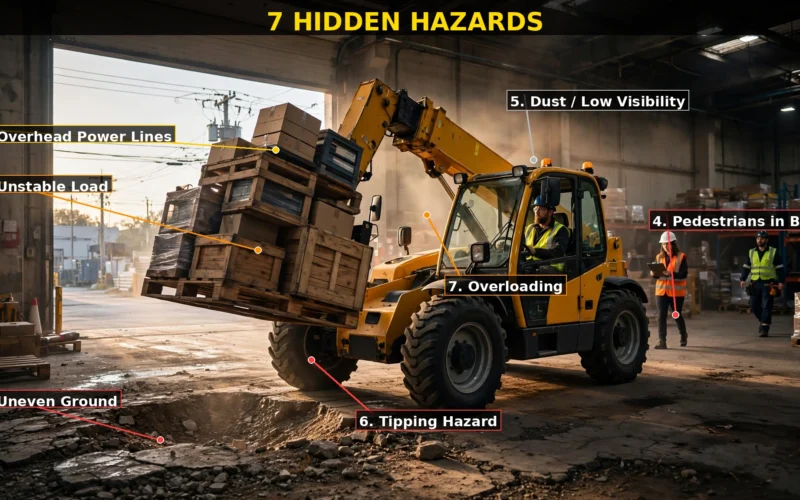
Many operators focus on the obvious dangers. Tipping. Falling loads. Collisions. But there are other hazards. Hidden hazards. Hazards that are not always obvious. Hazards that can injure or kill.
. Avoiding them is the second. Telehandler safety starts with awareness.
1. Operating on Soft or Uneven Ground
The ground looks solid. It looks safe. But looks can be deceiving. Rain softens the ground. Recent excavation weakens the soil. Hidden voids exist beneath the surface.
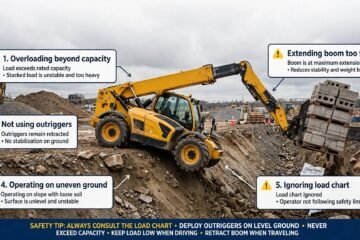
A telehandler needs stable ground. The outriggers spread the weight. But soft ground cannot support the weight. The machine tips. The load falls. The operator gets hurt.
Check the ground before setting up. Walk the area. Look for soft spots. Look for recent digging. Look for water accumulation. If the ground is soft, use mats. Steel plates spread the weight. They provide a stable base. They prevent tipping.
Do not trust the ground just because it looks solid. Test it. Probe it. Use common sense. Telehandler safety requires stable ground.
Even a slight slope changes the stability of the machine. The load shifts. The center of gravity moves. A machine that is stable on level ground becomes unstable on a slope.
Check the slope angle. If it exceeds the manufacturer recommendation, do not lift. Move the machine to level ground. It takes extra time. It is worth the effort. Ground conditions change throughout the day. Morning frost melts. Afternoon rain softens the soil. Excavation work creates new soft spots. Recheck the ground after any change.
2. Overlooking Overhead Power Lines
Power lines are everywhere. They run along roads. They cross job sites. They enter buildings. Operators forget about them. The boom reaches high. The operator raises it. It touches a power line. Electricity flows through the machine. The operator gets electrocuted.
Power lines do not need to be touched. Electricity can arc. It jumps from the line to the boom. The operator is still at risk.
Look up before lifting. Identify all power lines. Mark them with flags or tape. Maintain a safe distance. That distance is 10 feet at minimum. More is better.
If a power line is present, lower the boom. Move the machine. Do not work near power lines. Telehandler safety means staying clear of electricity.
High voltage lines are more dangerous. They carry more power. They arc further. Maintain a greater distance from high voltage lines. The safe distance is 20 feet or more. If contact occurs, stay in the machine. The ground around the machine becomes electrified. Exiting the machine creates a path for electricity. Wait for the utility company to de-energize the line.
Overhead lines are not always visible. Trees hide them. Buildings block the view. Walk the entire area before lifting. Identify every line. Do not assume the area is clear.
3. Improper Load Centering
The load is on the forks. It looks balanced. But it is not. The center of gravity is off. The load shifts. The machine tips.
Load centering is critical. The load must be centered on both forks. The weight must be distributed evenly. If the load is off-center, the machine becomes unstable. Check the load before lifting. Center it on the forks. Adjust the forks if needed. Use a spotter to help.
Do not assume the load is centered. Check it. Adjust it. A few seconds of checking prevents a tip-over. Telehandler safety requires balanced loads.
Off-center loads place stress on one side of the machine. The boom twists. The carriage bends. Hydraulic cylinders strain. This hidden damage accumulates over time. It leads to premature failure. Unbalanced loads also swing. The operator tries to correct the swing. The load moves further off-center. The machine tips. The load falls. Center every load. Check it from the side. Check it from the front. The load should be level on both forks.
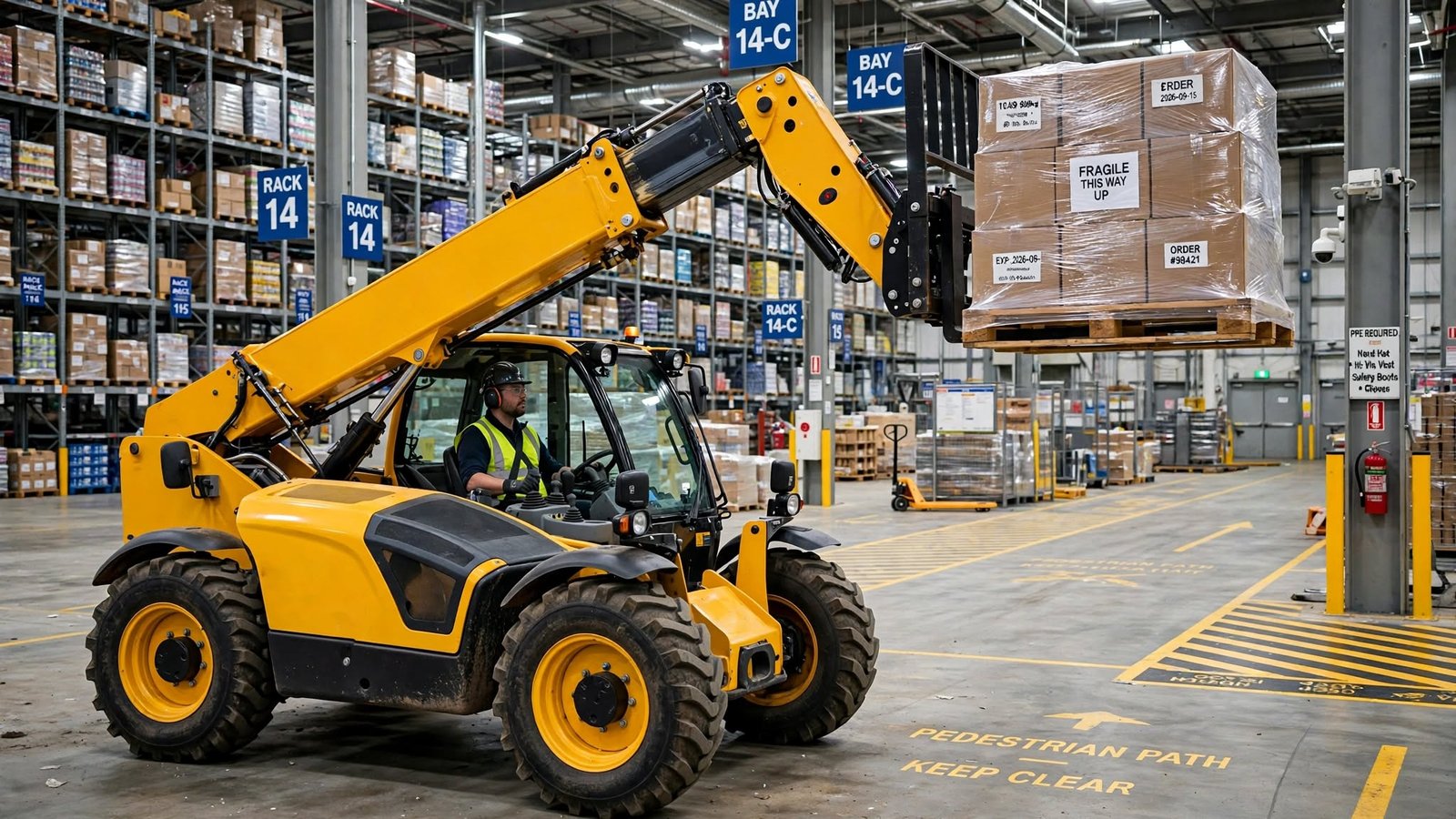
4. Using the Wrong Attachment for the Job
Attachments are useful. They expand what the machine can do. But using the wrong attachment is dangerous. Forks are for pallets. Buckets are for loose materials. Jibs are for extended reach. Platforms are for lifting workers. Each attachment has a specific purpose.
Using the wrong attachment causes problems. Forks on a bucket job. The material spills. The load becomes unstable. The machine tips. Using a platform without proper safety equipment. Workers fall. They get injured.
Match the attachment to the job. Do not improvise. Do not use makeshift attachments. Telehandler safety means using the right tool.
Some attachments change the machine’s capacity. A jib reduces lift capacity. A heavy bucket reduces lift capacity. The load chart must be adjusted. Check the load chart for each attachment. The capacity changes. Do not assume the same capacity applies. Adjust the load accordingly. Improper attachment installation is another danger. The attachment must lock securely. A loose attachment falls off. It injures workers. It damages materials.
5. Moving with the Boom Raised
The boom is raised. The load is in the air. The operator moves the machine. This is a common practice. It is also dangerous. A raised boom raises the center of gravity. The machine becomes unstable. A bump in the ground causes the machine to tip. The load falls. The operator gets hurt.
The boom should be lowered before moving. Keep it just above the ground. This lowers the center of gravity. The machine becomes stable. If the load must be moved, move slowly. Keep the boom as low as possible. Do not turn sharply.
Telehandler safety means keeping the boom low.
Traveling with a raised boom also damages the boom. The boom bounces. The bouncing stresses the boom sections. Cracks develop. The boom fails. Hydraulic cylinders also suffer. The bouncing forces fluid through the valves. The valves wear. The cylinders leak. The boom drops unexpectedly. Always lower the boom before traveling. It takes a few seconds. It prevents tip-overs. It prevents boom damage. It is worth the time.
6. Ignoring the Load Chart
The load chart is on the machine. It shows lifting capacity. It shows limits. Some operators ignore it. They think they know the capacity. They think the machine can handle more. They are wrong.
The load chart is based on engineering. It accounts for boom angle. It accounts for extension. It accounts for ground conditions. Ignoring the load chart causes tip-overs. The machine lifts too much. It tips forward. The load falls. The operator is injured.
Read the load chart before every lift. Understand the limits. Do not exceed them. Telehandler safety starts with the load chart.
The load chart changes with boom angle. A lower boom angle allows more capacity. A higher boom angle reduces capacity. The chart provides exact numbers. The load chart also changes with boom extension. A fully retracted boom allows more capacity. An extended boom reduces capacity. Check the chart for each lift.
Some machines have electronic load systems. They warn the operator when the capacity is exceeded. But these systems are not foolproof. They fail. They get ignored. Trust the load chart for proper telehandler safety.
7. Not Using a Spotter in Blind Spots
Telehandlers have blind spots. The boom blocks the view. The carriage blocks the view. The operator cannot see everything. A spotter is essential. The spotter guides the operator. The spotter sees what the operator cannot. The spotter prevents collisions.
Some operators skip the spotter. They think they can see. They think they know the area. They are wrong. Use a spotter in tight spaces. Use a spotter when visibility is limited. Use a spotter when reversing. The spotter must be trained. They must use hand signals. They must maintain eye contact with the operator.
Telehandler safety requires a spotter.
A spotter should be used in all confined areas. Barns. Warehouses. Narrow streets. The operator cannot see the boom tip. The spotter provides that visibility. The spotter should also check overhead clearance. The operator may forget. The spotter watches for obstacles. The spotter stops the operator before a collision. Spotters should wear high-visibility vests. They should be clearly visible to the operator. Hand signals should be agreed upon before work begins.
Why Telehandler Safety Matters
Safety is not just about avoiding injury. It is about productivity. A safe job site is a productive job site. Accidents stop work. Injuries stop work. Investigations stop work. Safety also affects morale. Workers who feel safe are more productive. They work faster. They work better.
Safety affects costs. Accidents cost money. Medical bills. Insurance claims. Legal fees. Equipment damage.
Telehandler safety protects workers. It protects the machine. It protects the bottom line.
Regulations also require strict telehandler safety. OSHA has specific rules for telehandler operation. Violations carry fines. Fines cost money. Bad publicity costs more. Insurance companies reward safety. Lower premiums for safe operators. Lower deductibles for safe companies. Safety pays.
Telehandler Safety Checklist
Use this checklist every day. It covers the basics.
| Item | Check |
|---|---|
| Ground conditions | Stable and level |
| Overhead hazards | Power lines marked |
| Load centering | Balanced on forks |
| Attachment | Correct for the job |
| Boom position | Lowered when moving |
| Load chart | Read and understood |
| Spotter | Present and trained |
Check these items before starting work. Telehandler safety is not optional.
Additional Telehandler Safety Tips
Wear the Seat Belt
Seat belts save lives. They keep the operator in the seat. They prevent ejection during a tip-over. Wear the seat belt every time. Do not start the machine without it.
Keep the Boom Low
A raised boom is unstable. Keep it low when traveling. Raise it only when placing loads. Lower it immediately after placing the load.
Avoid Slopes
Slopes are dangerous. The machine tips. The load shifts. Avoid slopes when possible. If a slope is necessary, reduce the load. Keep the boom low. Drive straight up or down.
Maintain Visibility
Clean the windows. Adjust the mirrors. Use the lights. The operator must see clearly. Debris on windows blocks the view. Dust on mirrors hides obstacles. Keep everything clean.
Inspect Daily
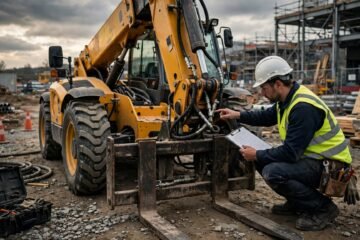
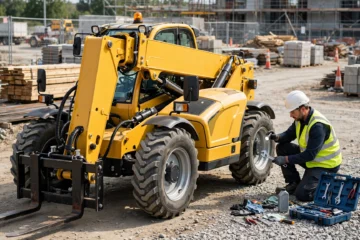
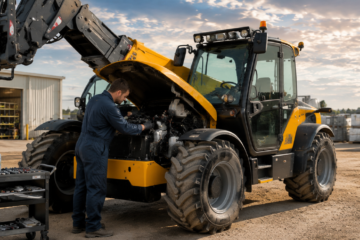
Walk around the machine. Check for leaks. Check for damage. Fix problems before they become accidents.
Common Telehandler Safety Mistakes
Overconfidence: The operator thinks they know the machine. They take shortcuts. They ignore safety rules. This confidence leads to accidents.
Rushing: Deadlines are tight. The operator rushes. They skip steps. They make mistakes. Rushing causes accidents.
Fatigue: Long hours cause fatigue. Tired operators make errors. Errors cause accidents. Take breaks. Rest when tired.
Distraction: Phone calls. Conversations. Distractions. The operator loses focus. The machine tips. Stay focused.
Inexperience: New operators lack experience. They make mistakes. They need training and supervision. Do not let new operators work alone.
Telehandler Safety Training
Training is essential. Every operator must be trained. Training covers operation. Training covers safety. Training covers hazards. Formal training is available. Courses are offered by dealers and associations. Courses cover classroom and practical training.
Refresher training is also important. Skills fade over time. New hazards emerge. Regular training keeps skills sharp. Training should include hands-on practice. Operators should practice in a safe environment. They should lift loads. They should maneuver in tight spaces. They should practice emergency procedures.
Emergency Procedures
Accidents happen. Be prepared. Know what to do.
- Tip-Over: If the machine tips, stay in the seat. Do not jump. The seat belt keeps the operator safe. Wait for help. Do not try to exit.
- Power Line Contact: If the boom touches a power line, stay in the machine. Do not exit. Electricity can arc. Wait for the utility company.
- Fire: If the machine catches fire, shut off the engine. Use a fire extinguisher. Call for help. Evacuate the area.
- Injury: If someone is injured, call for medical help. Do not move the injured person. Wait for professionals. Provide first aid if trained.
Our Business Partner
Final Thoughts
Telehandler safety saves lives. It also saves money. A safe machine is a productive machine. A safe operator is a productive operator.
Seven hidden hazards put operators at risk. Operating on soft ground. Overlooking power lines. Improper load centering. Wrong attachments. Moving with a raised boom. Ignoring the load chart. Not using a spotter. Avoid these hazards. Use the checklist. Follow the tips. Stay trained. Be prepared.
Telehandler safety starts with awareness. Know the hazards. Avoid them. The machine will be safe. The operator will be safe. The job site will be safe.