
Table of Contents
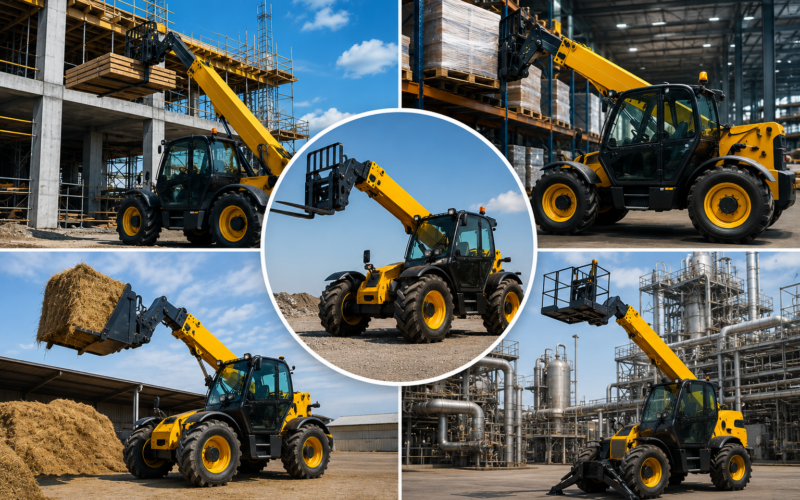
You see telehandlers on many job sites. But you might not know how many industries use them for different telehandler applications. These machines are not just for construction. They work in farming, warehousing, and emergency response too.
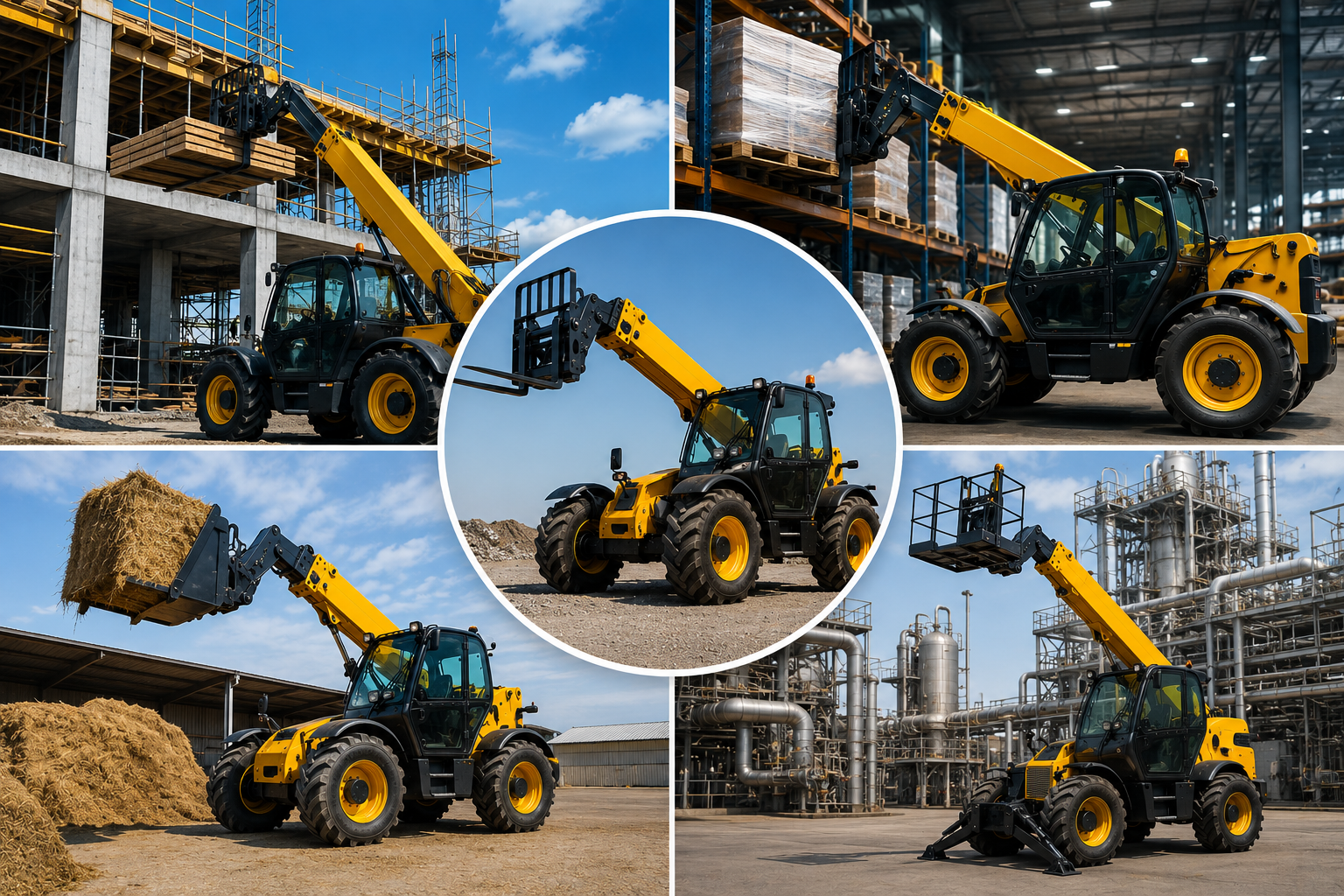
Each industry uses telehandlers differently. Each has specific needs. This guide covers 4 industries where telehandlers work best. You will see how each industry uses the machine.
You will learn which features matter most for each of these telehandler applications. Let’s dive in.
Industry 1: Construction Telehandler Applications
Construction is the largest market for these machines. You find them on almost every building site. They handle materials from ground to roof.
Common Construction Tasks
Construction sites need material movement. You lift bricks, blocks, and beams to upper floors. Telehandlers work with scaffolding. They position heavy tools and generators.
Demolition crews use specific telehandler applications too. They pull down walls and remove debris. For this, crews switch between forks, buckets, and platforms. To understand how to expand this capability, read our telehandler attachments guide.
Why Telehandlers Work Here
Construction sites have rough ground. Telehandlers handle mud and gravel. They do not get stuck like forklifts. Four-wheel drive is essential, and a load chart is critical to know your limits for each lift.
Industry 2: Agriculture Telehandler Applications
Farming is the second largest market. Farmers use them year-round. They handle feed, hay, and supplies.
Common Agricultural Tasks
Farms use telehandlers for daily chores. You move hay bales and feed. Modern telehandler applications work efficiently in feedlots. You move silage to feeding areas and clean manure from pens.
Why Telehandlers Work Here
Farms have muddy fields. Telehandlers with large tires keep moving. One machine handles feed, cleaning, and loading. Large tires and easy controls are essential features for agriculture.
Industry 3: Warehousing and Logistics Telehandler Applications
Warehouses and distribution centers rely heavily on indoor telehandler applications. They move bulk materials on uneven floors.
Common Warehousing Tasks
Warehouses need bulk storage. You place items on high racks and retrieve materials from upper levels. If you only do straightforward vertical lifting in tight spaces, you might also consider an electric wheel scissor lift, but a telehandler gives you forward reach into trailers.
Why Telehandlers Work Here
Telehandlers provide height without ladders. Compact models fit between racks. Non-marking tires are often required so they leave no black marks on concrete floors.
Industry 4: Emergency Response Telehandler Applications
Emergency services use telehandlers. They clear debris. They lift rescue equipment. They access damaged structures.
Common Emergency Tasks
Disaster response involves critical telehandler applications. You clear rubble from collapsed buildings. Flood response utilizes telehandlers to move sandbags. Wildfire response uses these machines to move water tanks and clear firebreaks.
Why Telehandlers Work Here
Emergency sites have unstable ground. Telehandlers with wide stances stay stable. You operate where other machines cannot. Stability systems and quick attachment changes are essential.
Industry Comparison Table for Telehandler Applications
| Industry | Primary Use | Key Feature | Best Attachment |
|---|---|---|---|
| Construction | Material lifting | Four-wheel drive | Forks, Bucket |
| Agriculture | Feed and hay handling | Large tires | Bucket |
| Warehousing | Bulk storage | Compact size | Forks |
| Emergency Response | Debris clearing | Stability | Bucket, Winch |
Choosing the Right Machine for Your Telehandler Applications
Each industry needs different features. Match your telehandler to your work.
- For Construction: Choose four-wheel drive and a load chart.
- For Agriculture: Choose large tires and a bucket.
- For Warehousing: Choose a compact telehandler with non-marking tires.
- For Emergency Response: Choose stability systems and quick attachment change capabilities.
Common Mistakes in Various Telehandler Applications
Construction Mistakes: Buying a machine without enough reach or skipping four-wheel drive.
Agriculture Mistakes: Buying a machine with small tires or ignoring proper bucket size.
Warehousing Mistakes: Buying a machine that is too large or ignoring floor marking rules.
Emergency Response Mistakes: Buying a machine without stability systems.
The Future of Telehandler Applications
Telehandlers are evolving. New technologies expand their uses. Electric models are coming. They produce no emissions. Warehouses and indoor construction will use electric models for emission-free telehandler applications.
Remote control telehandler applications are being developed. Operators work from a safe distance, which is perfect for emergency response. Telematics and data track hours and loads to improve efficiency.
Our Business Partner
Bottom Line
Exploring these telehandler applications shows how versatile the machine is. Construction uses them for lifting, agriculture for feed, warehousing for storage, and emergency response for rescue.
Each industry needs different features to master its operations. Choose based on your work. Match the machine to your application. They save you money and make your work easier.
Understand your industry needs and master your telehandler applications. Your industry depends on material movement, and telehandlers keep your business running smoothly.